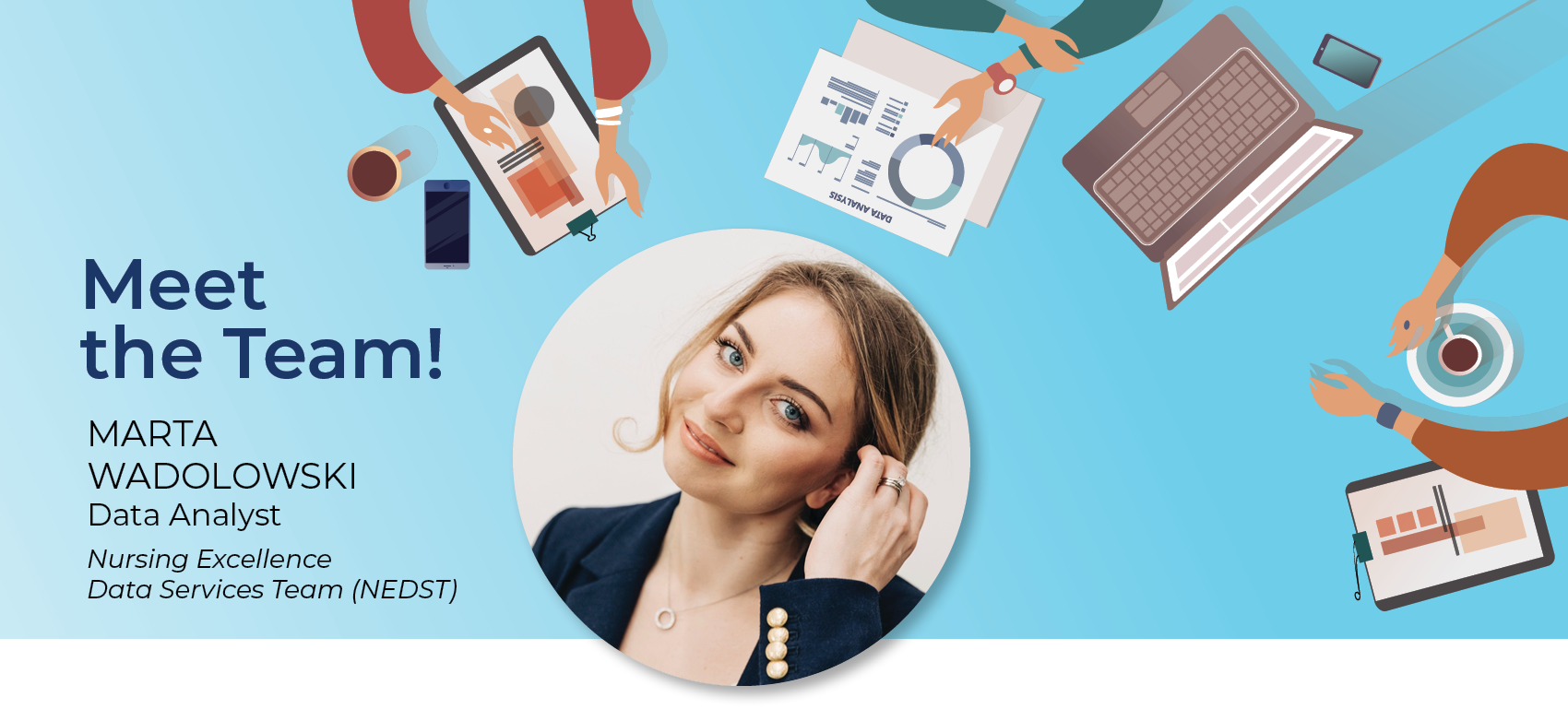
Marta Wadolowski is a Nursing Excellence Data Analyst on Tipton Health’s Data Services team, where her primary focus is supporting organizations throughout their Magnet® Designation journeys. She brings experience in insurance and medical data to her work, along with a strong analytical foundation in mathematics and a passion for helping healthcare organizations understand the story behind their numbers. Marta finds the greatest fulfillment in knowing her analyses support nursing excellence and ultimately enhance patient care. We talked with Martha about her time at Tipton Health, advice she has for our nursing partners, and the things she’s passionate about.
What did you do before joining Tipton Health?
Before joining Tipton Health, I worked in the insurance industry, where I spent a lot of time working with client data. That’s really where my interest in data analysis began — I became fascinated by how much insight you can uncover when you look closely at the numbers. I later moved into a role focused on medical data, which is when everything really clicked for me. I realized that healthcare analytics was the direction I wanted to pursue. I hold a degree in Mathematics, and that background gave me a strong foundation in analytical thinking and problem-solving, which naturally led me toward data analytics. To build on that foundation, I completed a data analytics bootcamp to sharpen my technical skills and expand my expertise. Combining my education, previous experience, and growing interest in healthcare data ultimately led me to Tipton Health — where I’ve been able to apply all of those pieces in a way that feels both meaningful and rewarding.
How would you describe your experiences working on the Data Services Team?
I truly love being part of the Data Services Team. It is rare to find a workplace where you are passionate about what you do, know that your work has meaningful impact, and feel genuinely supported by your colleagues. Our work is often complex and requires both technical precision and empathy. We understand that behind every dataset are real nurses doing incredibly demanding and important work. Our role is to ensure their excellence is clearly reflected in the data. We take great pride in helping our clients shine through the numbers. The team environment is collaborative, supportive, and growth-oriented. We challenge ourselves professionally while also maintaining a culture of respect and camaraderie. I am very proud to be part of a team that consistently puts clients first and approaches every project with both rigor and heart.
Is there anything that you wish our nursing partners knew at the beginning of their Magnet Designation journeys?
From a data perspective, one of the biggest challenges in analysis often stems from differences in technical and clinical language. As data analysts, we may not have detailed nursing-specific operational knowledge, and understandably, nursing teams may not always be familiar with technical data structures. This is exactly why the Unit-Level Data Crosswalk (ULDC) is so essential. The ULDC serves as a bridge — translating the current state of a facility’s data into a shared understanding that provides context and clarity for accurate analysis. Having a completed and comprehensive ULDC before final analysis begins significantly enhances our ability to deliver precise and meaningful results. It creates a strong foundation for collaboration and ultimately strengthens the story your data tells.
Do you have any advice for our partners as they move further into their designation journeys?
The Magnet journey can feel overwhelming at times — especially with deadlines, documentation requirements, and the high standards you hold yourselves to. My advice is simple: do not carry that stress alone. We are here for you.
One of the reasons organizations choose Tipton Health is because of our experience, flexibility, and deep commitment to partnership. If something does not look right, we will do everything possible within the process to address it. We approach every engagement with dedication and accountability. Focus on what you do best — caring for patients and leading your teams. Allow us to focus on the analysis. We are confident in our expertise and committed to supporting you every step of the way. And most importantly, be open and transparent with us. The more we understand your context, the better we can serve you.
Speaking of advice, is there anything you can tell us about the Fab 5 that will make it easier for our partners?
If I could offer one piece of advice, it would be this: start early, and focus on clarity. Ensuring that your data definitions are consistent and your unit structures are clearly documented before final submission makes a tremendous difference. Small alignment efforts at the beginning save significant stress later. Patient experience data, in particular, often feels the most complex due to its structure and reporting nuances. However, this is something our Data Services team works with regularly. We understand the intricacies and know how to present the data in a way that accurately reflects your performance.
Most importantly, remember that the Fab 5 is not about perfection — it is about transparency, context, and demonstrating your commitment to continuous improvement. Our role is to help you tell that story clearly and confidently.
Do you have a favorite Magnet® example or one that you think does a better job than most to showcase the hard and excellent work our nursing partners put in along their journeys?
If I had to choose, I would say EP3EO — RN Satisfaction/Engagement. This example stands out to me because it gives nurses a direct voice. The data reflects how supported, valued, and empowered they feel within their organization. It is not just about outcomes; it is about culture.
When we analyze RN satisfaction data, we are helping to tell a story about leadership, teamwork, professional development, and the daily work environment. Strong results in this area demonstrate that excellence is not accidental, but rather, it is intentional and sustained. I also see tremendous value in EP3 beyond the designation process itself. Sometimes leaders may sense that something feels “off” within a team, but it can be difficult to pinpoint exactly where the issue lies. EP3 insights help bring clarity. The data can highlight specific strengths while also identifying areas that may need attention, allowing organizations to respond thoughtfully and proactively.
What are you most proud of working at Tipton Health so far?
I am proud that the designations I have worked on contribute to positive impact. At some point in life, most of us become patients, whether it’s during major milestones, or in everyday situations like a routine visit, a minor procedure, or caring for a loved one. Nursing care touches everyone. Knowing that my work plays even a small role in strengthening the quality of that care is incredibly meaningful to me. That connection between data and real human outcomes is what makes me the most proud to be part of Tipton Health.
What hobby are you most passionate about and why?
When I was younger, I had so many hobbies that my parents could barely keep up with my ideas. I explored everything from ballroom dancing and sewing with my mom to building airplane models with my dad. At one point, I was even a singer in a rock band and tried horseback riding. I have always enjoyed learning new skills and challenging myself.
Now, in my 30s, after trying so many different things, I no longer dedicate myself seriously to just one hobby — my interests tend to evolve over time. Currently, when I find a quiet moment for myself, I enjoy crocheting. I recently made crochet decorations for my eight-month-old daughter’s nursery, and seeing those small handmade pieces come together was incredibly satisfying. I think hobbies naturally change as we move through different stages of life, and that is part of their beauty. For me right now, crocheting offers a sense of calm and focus, which is something I truly appreciate.