
A new council org chart won’t fix nursing governance. What leaders do inside it every day will.
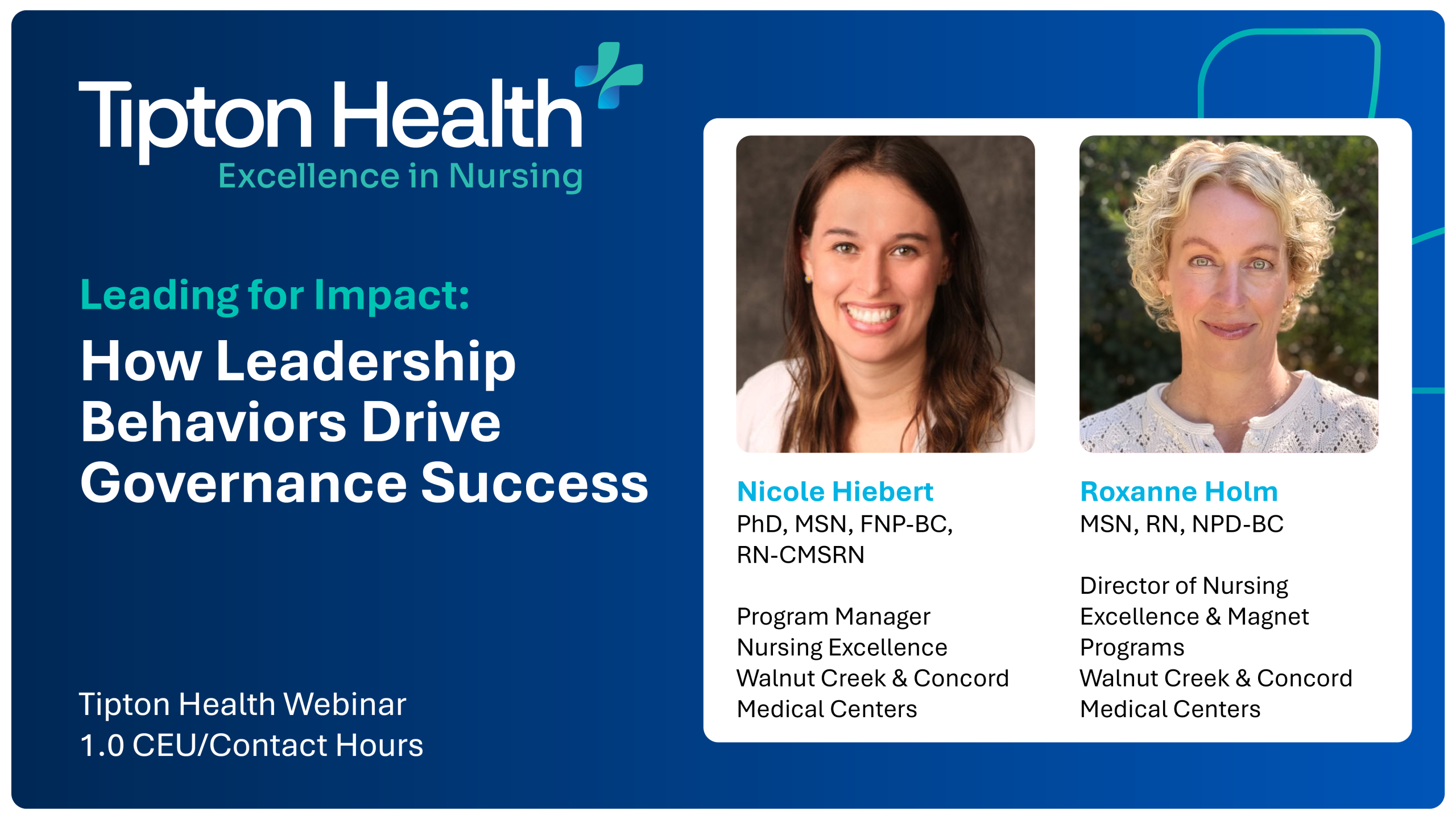
Insights from Roxanne Holm, MSN, RN, NPD-BC, and Nicole Hiebert, PhD, RN, CMSRN, of John Muir Health, shared in Tipton Health’s August 12 webinar, moderated by Pam Power, DNP, MSN, BSN, ACNS-BC, Chief Nursing Officer, Tipton Health.
Strong nursing governance does not come from a better council chart. It comes from how leaders behave inside the structure they already have. That was the core message from Roxanne Holm and Nicole Hiebert of John Muir Health during Tipton’s recent webinar. When leaders show presence, remove barriers, and make it safe to speak up, councils shift from sharing information to making decisions.
Structure and Culture Are Not the Same Thing
Structure is the framework. Culture is what happens inside it. Governance structure is the councils, charters, roles, and meeting schedules. Governance culture is whether nurses feel ownership, speak candidly, and follow through. Holm and Hiebert argued that many organizations over-invest in the first and neglect the second. You can redraw every council chart and still run meetings where no real decisions get made.
Structure Alone Falls Short
Because a structure with no accountability just moves information around. Before their redesign, John Muir Health ran two medical centers with different council structures. Meetings centered on information sharing, not decision making. Ownership was unclear, membership was inconsistent, and nurse leaders were either absent or overshadowing the group. A Nursing Excellence Assessment, conducted by Tipton Health, confirmed what nurses already felt: the bones were there, but the behavior was not. A survey using a 5 point Likert scale found that professional governance scored 2.83 when all questions were considered. This score indicated that the lived experience of clinical nurses in professional governance was not what the nursing team aspired to.
The research agrees. In their 2021 JONA article, Tim Porter-O’Grady and Joanne Clavelle argued that shared governance must evolve into professional governance built on accountability, professional obligation, and shared decision making. Structure is necessary, they note, but on its own it is not enough.
Leadership Behaviors Build Psychological Safety
Leaders create safety by showing up, asking honest questions, and protecting nurses who speak up. Holm and Hiebert pointed to four leadership behaviors that change culture: providing resources, exhibiting presence and humble inquiry, removing barriers, and supporting professional development. Each one signals that a nurse’s voice matters.
That safety is the engine. Harvard’s Amy Edmondson defines psychological safety as the confidence to share ideas, questions, concerns, and mistakes without fear. In a psychologically safe council, nurses raise problems early, challenge assumptions, and own the outcome. A 2025 scoping review the presenters cited ties that safety to stronger nurse well-being, collaboration, and quality of care.
Inside John Muir Health’s Council Redesign
The team rebuilt the councils around protected time, clear roles, and strategic alignment. Rather than tweak the chart, a diverse group of clinical nurses, NPDs, and leaders redesigned the charters, functions, roles, budget, and meeting structure. The changes that mattered most:
- Protected time. One monthly council day, backed by the CNO, with budgeted hours for members and chairs.
- Redefined roles. The nurse leader moved from coach to executive sponsor, and the NPD became the coach.
- Strategic alignment. Council work now maps to the Magnet® Model, organizational priorities, and the nursing strategic plan.
The Results Eighteen Months Later
Engagement, trust, and accountability all rose as psychological safety took hold. Eighteen months after the redesign, the team ran focus groups across every council role. Members, chairs, coaches, and executive sponsors all named psychological safety and visible leadership support as strengths to sustain. Participation climbed, council applications hit record numbers, and follow-through grew more consistent.
The remaining opportunities were telling: attendance, role clarity, and new-chair onboarding. In other words, the next gains will also come from behavior, not from another redesign.
Frequently Asked Questions
What is professional governance in nursing?
Professional governance is a model where nurses own their practice and make decisions about quality, competence, and knowledge. It builds on shared governance by adding accountability and professional obligation, per Porter-O’Grady and Clavelle (2021).
What is the difference between governance structure and governance culture?
Structure is the councils, charters, and roles on paper. Culture is how people actually behave inside that structure. Strong structure with weak culture still produces meetings that share information but decide nothing.
How do nurse leaders create psychological safety?
They stay present, ask genuine questions, remove barriers, and respond well when nurses raise concerns. These behaviors tell nurses their voice is valued, which is the heart of psychological safety.
How long does a governance redesign take to show results?
John Muir Health saw meaningful change within 18 months. Research suggests full cultural adoption of professional governance can take three to five years.
Key Takeaways
The John Muir Health story lands on three ideas every nurse leader can act on:
- Behavior drives culture, not structure alone.
- Psychological safety fuels nurse ownership of professional governance.
- Protected time and clear roles turn councils into engines of impact.
A new chart is the easy part. The harder, higher-value work is how leaders show up once the chart is drawn.
Build Governance That Actually Changes Culture
Tipton Health, a nursing excellence consultancy that has supported more than 300 hospitals on their nursing excellence journey, with a 100 percent Magnet® and Pathway to Excellence® designation success rate, helps teams build governance that actually shifts behavior. If your team needs guidance on how to build or strengthen shared governance at your organization reach out today. You can set up time to talk here.